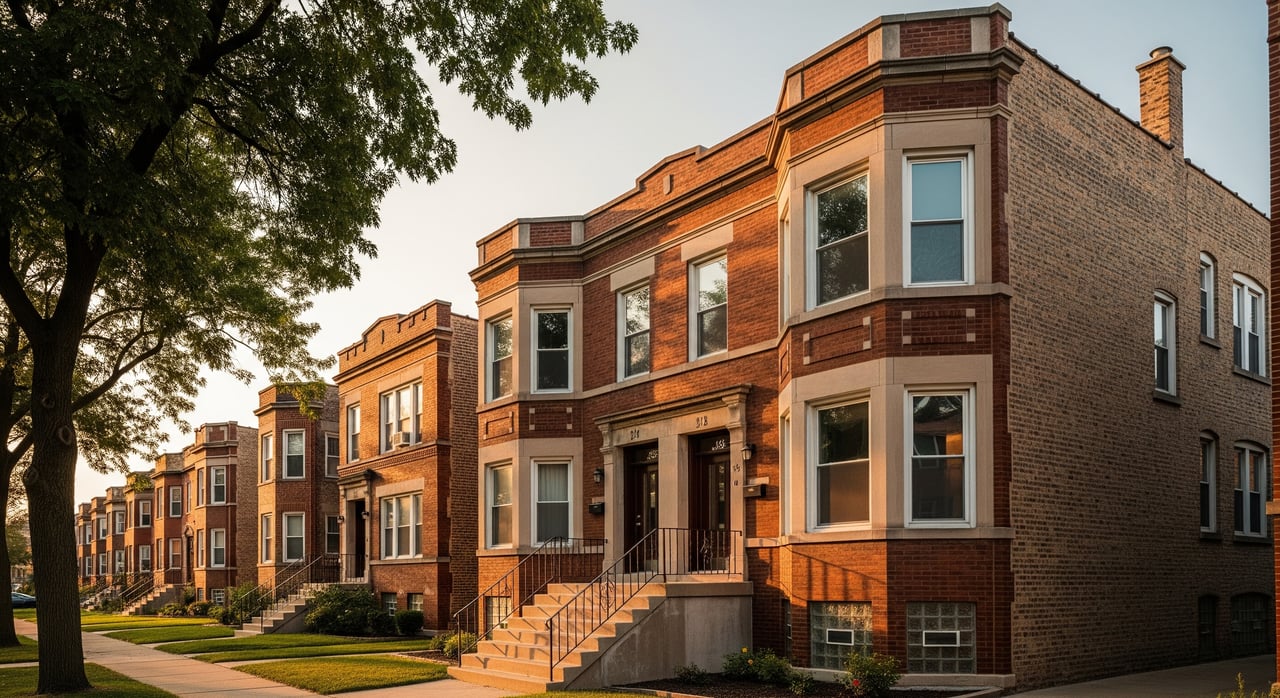
Pricing a 2-flat can feel tricky. You have two sets of rents, shifting expenses, and a market that moves fast. If you get it wrong, you leave money on the table or sit on the market too long. You want a clear, repeatable way to land on a defensible price.
This guide gives you a simple, step-by-step method that works for Logan Square and similar Illinois markets. You will learn how to use rents, NOI, cap rates, GRM, and recent sales to triangulate a smart list price. You will also see how condition, taxes, zoning, and financing affect value. Let’s dive in.
The 4-step pricing method
1) Gather local income and expense inputs
Start with the numbers that actually drive value.
- Rents: Confirm current leases and estimate market rents by unit type and size. Use recent rental activity and signed leases when available.
- Vacancy: Use a local assumption as a starting point. Many urban neighborhoods run in the 4–8% range. Validate with property managers or recent experience.
- Operating expenses: Pull the current tax bill, insurance, and owner-paid utilities. Include management, repairs and maintenance, landscaping, legal/accounting, and reserves for capital items.
- Property details: Note unit mix, legal unit count, zoning, ADU potential, and parking. Verify permits and legality for any basement or garden units.
- Condition: Categorize as good, average, or poor. Adjust expected rents and reserves based on updates and deferred maintenance.
2) Build a simple income statement
Use these formulas to estimate income and NOI.
- Annual Gross Rent = (rent unit A + rent unit B) × 12
- Effective Gross Income (EGI) = Annual Gross Rent × (1 − vacancy) + other income (parking, storage, laundry)
- Operating Expenses = sum of recurring annual expenses (exclude mortgage)
- Net Operating Income (NOI) = EGI − Operating Expenses
As a cross-check, many small multifamily properties land in a 30–45% operating expense ratio range, but your actual bills and owner-paid utilities matter most.
3) Apply cap rate and GRM for value
Run two investor-focused methods and compare.
- Cap rate approach: Value = NOI ÷ market cap rate. In stable urban neighborhoods, small multifamily cap rates often fall around 4–7%. Use recent investor sales to select a realistic cap rate for the building’s condition and location.
- GRM quick check: Value ≈ Annual Gross Rent × GRM. For many urban 2-flats, GRMs often range near 8–12. Derive GRM from comparable recent sales whenever possible.
4) Cross-check with recent sales comps
Pull 2-flat sales from the past 6–12 months and adjust for:
- Unit mix and square footage
- Condition and level of updates
- Lot size, parking, and outdoor space
- Location factors, including proximity to transit and local amenities
If cap-rate value, GRM value, and comps diverge, revisit inputs. Check your rent assumptions, vacancy, expense lines, and the quality of your comps.
Hypothetical example (for illustration)
The numbers below are a simple example to show the math. They are not a market quote.
- Unit A rent: 2-bed at $2,200/month
- Unit B rent: 2-bed at $2,000/month
- Annual Gross Rent = ($2,200 + $2,000) × 12 = $50,400
- Vacancy: 6% starting assumption
- Other income: $600/year (parking)
- EGI = $50,400 × 0.94 + $600 = $47,976
- Operating expenses: assume 40% of EGI = $19,190
- NOI = $47,976 − $19,190 = $28,786
Valuation checks:
- Cap rate method at 5.5%: $28,786 ÷ 0.055 ≈ $523,000
- GRM method at 10: $50,400 × 10 = $504,000
- Sales comps: if recent, similar-condition 2-flats suggest mid $500s, you might triangulate a range around $510,000 to $530,000 for list planning.
Your actual value will depend on current rents, condition, expenses, and true local cap rates and GRMs.
Logan Square factors that move price
- Transit and amenities: Proximity to CTA Blue Line stations and active retail corridors can support stronger rents and lower vacancy. Limited parking can matter less for tenants who prioritize transit.
- Zoning and overlays: Parts of Logan Square include landmark or boulevard districts. Exterior changes may require review and permitting, which affects renovation timelines and ADU potential. Always verify the zoning for basement or coach house conversions and any parking requirements.
- Taxes and classification: Cook County assessments and tax classifications for small multifamily differ from single-family. Confirm the current tax bill and assess appeal options.
- Investor depth: Urban neighborhoods often draw a mix of owner-occupants and investors, which can compress cap rates and support stronger pricing for well-positioned buildings.
Boone County or small-town adjustments
If you are pricing a similar 2-flat in a small-town setting or Boone County, plan for different dynamics.
- Rent sensitivity: Achievable rents are often lower and driven by local employment and commuting patterns rather than transit access.
- Comps and stability: Fewer recent 2-flat sales can make GRM and cap-rate estimates less stable. Lean more on local landlord income data and experienced brokers.
- Zoning and permitting: Rules may be simpler and without landmark overlays, but always confirm local code and ADU allowances with the municipality or county.
- Parking: Off-street parking is more common and may be less of a rent driver.
How condition and ADU potential affect value
- Condition categories: Good condition supports stronger rents and lower reserves. Average or poor condition requires higher reserves or price deductions.
- Pricing for repairs: Estimate the cost to cure and either subtract it from market value or increase reserves and re-run your NOI and cap-rate math.
- ADU potential: If zoning and code allow a legal basement or coach house, model the added NOI after accounting for construction cost, time to permit, parking requirements, and utilities. The incremental NOI is what drives added value.
Owner-occupant vs investor pricing
A building that works for an owner-occupant often attracts a larger buyer pool. Residential financing can mean lower rates and higher loan-to-value compared to investor loans. That broader demand can support a premium. Investors, by contrast, will underwrite to market rents, stabilized vacancy, and a target cap rate.
Pricing strategy and timing
Your list strategy should reflect current supply and buyer behavior. Pricing slightly below your triangulated value can increase showings and help create competition. Overpricing tends to lengthen time on market. Clean documentation and quick responses also help you protect price.
What to prepare: seller checklist
- Current rent roll and copies of all leases
- Recent utility, insurance, and tax bills
- A list of recent improvements with receipts
- Inspection report or list of known issues
- Zoning and parcel ID, plus any historic or boulevard overlay notes
What to verify: buyer and owner-operator checklist
- Confirm permitted unit count and legality of each rental unit
- Compare nearby rents for the same building type and similar blocks
- Order a full inspection and request repair and maintenance records
- Review insurance history and current premiums
Next steps and how we help
If you want a data-backed price with investor-grade underwriting, follow the method above and then validate with fresh comps. Our team pairs local market knowledge with operational know-how, from valuation and listing prep to contractor coordination and digital-first marketing. Whether you plan to live in one unit, buy as an investment, or prep a value-add strategy, we can help you model NOI, evaluate ADU options, coordinate rehab, and position the asset for maximum exposure.
Ready for a pricing consult on your 2-flat? Connect with Spacematch Inc. and we will walk you through a clear, defensible valuation and go-to-market plan.
FAQs
What data do I need to price a Logan Square 2-flat?
- Gather current and market rents, a realistic vacancy rate, full operating expenses (taxes, insurance, owner-paid utilities, maintenance, management), condition notes, and recent 2-flat sales.
Should I use GRM or cap rate when valuing a 2-flat?
- Use both: GRM is a fast check based on gross rent, while cap rate uses NOI for a more rigorous investor view; cross-check both against recent sales comps.
How does owner-occupancy impact price for a 2-flat?
- Properties that qualify for owner-occupant financing often see stronger demand and can command a premium compared to strictly investor-targeted listings.
Do ADUs add value in Logan Square 2-flats?
- They can if legal and well-executed; model the incremental NOI after factoring construction cost, permitting time, any overlay reviews, parking needs, and utilities.
How do property taxes factor into my pricing?
- Use the current tax bill in your operating expenses and consider appeal potential; taxes flow through NOI, which directly impacts cap-rate based value.
How is pricing different in Boone County versus Chicago?
- Expect lower achievable rents, fewer comps, and a heavier reliance on local landlord data; zoning and permitting may be simpler, and parking usually matters less.
